
Review · BUDAPEST
Budapest: Private Food Tour – 10 Tastings with Locals
Budapest’s food story is best understood one bite at a time, and this three-hour private tour gives you plenty to try. You’ll sample 10 Hungarian foods and drinks while walking between the Great Market Hall, the Jewish Quarter, Szimpla Kert, the Great Synagogue, and other central sights. Lángos, chimney cake, sausage, paprika, sour cream, and hearty goulash all get their turn.
I like the private format, since your guide can ask about your tastes and adjust the route. I also like the way the tour joins food with local history instead of treating each snack as an isolated stop. The main catch is timing: on Sundays, the Great Market Hall and many food businesses are closed, so book another day if the market is a priority.
Key points to know before you book
- Ten tastings in three hours: Expect a full meal’s worth of food, not just a few token samples.
- The Great Market Hall sets the scene: You meet outside the market and may taste Hungarian staples before continuing through central Budapest.
- Lángos and chimney cake are central treats: You get two famous Hungarian classics in local settings.
- Your guide shapes the afternoon: Guides such as Nick, Beata, Gabor, Tibi, Nelli, and Emoke have tailored the experience around food interests and dietary needs.
- Sunday has a real limitation: The market and many restaurants may be closed, which can reduce the choice of stops.
- Not suited to every visitor: Comfortable shoes are needed, and the tour is not suitable for wheelchair users or people with mobility impairments.
What this Budapest food tour is really about
This is not a sit-down meal stretched over three hours. It is a moving introduction to Budapest through small portions, drinks, market stalls, casual eateries, and city landmarks.
You meet your English-speaking host outside the Great Market Hall. From there, the route links food stops with short walks and sightseeing. The exact menu can change because this is a private experience, but the aim is clear: 10 local tastings covering savory dishes, sweets, and drinks.
That mix matters. Hungarian food is more than goulash and paprika. You may taste sausage and bread, a filling goulash soup, sour cream-based dishes, pastries, lángos, chimney cake, and local drinks. The guide also explains ingredients and customs, including the different kinds of paprika used in Hungarian cooking.
I especially like the food-and-city combination. You are not spending the full afternoon in one market or restaurant. Instead, each stop gives you a reason to move through Budapest, with stories about the Great Synagogue, Szimpla Kert, the market, and the surrounding neighborhoods along the way.
More Food Tours with Locals in the world:
- Naples: Street Food Walking Tour with Local Guide
★ 4.9 · 4,976 reviews - Rome: Street Food Tour with Local Guide
★ 4.8 · 4,077 reviews - Eat Like a Local: Venice 3-Hour Small-Group Food Tasting Tour
★ 5.0 · 3,137 reviews
Starting at the Great Market Hall
The Great Market Hall is a sensible meeting point because it immediately puts Hungarian food in front of you. Meet your host outside the entrance, then expect a short introduction to the market and its role in local eating and shopping.
The market is a useful first stop for getting your bearings. You might see paprika, cured meats, sausages, bread, sweets, and other Hungarian products before tasting some of them. One route included sausage and bread, followed by time to look around and buy products from a stall.
That shopping opportunity is handy if you want to take paprika or packaged food home. Still, remember that the tour is not a dedicated market-shopping trip. The guide’s main job is to keep the tastings moving, and three hours passes quickly.
The biggest practical issue is the day of the week. The Great Market Hall is generally not operating as a full food destination on Sundays, and many restaurants are closed then as well. A Sunday tour can still work, but the route may rely more on open food spots and alternative locations. If the market matters to you, choose a weekday or Saturday.
Lángos, sausage, and the savory side of Hungary
Lángos is one of the essential Budapest foods, and this tour gives you a chance to taste it in a local setting. The classic version is a fried flatbread, often served with sour cream and cheese. It is filling, salty, and not delicate, so do not arrive expecting ten tiny canapés.
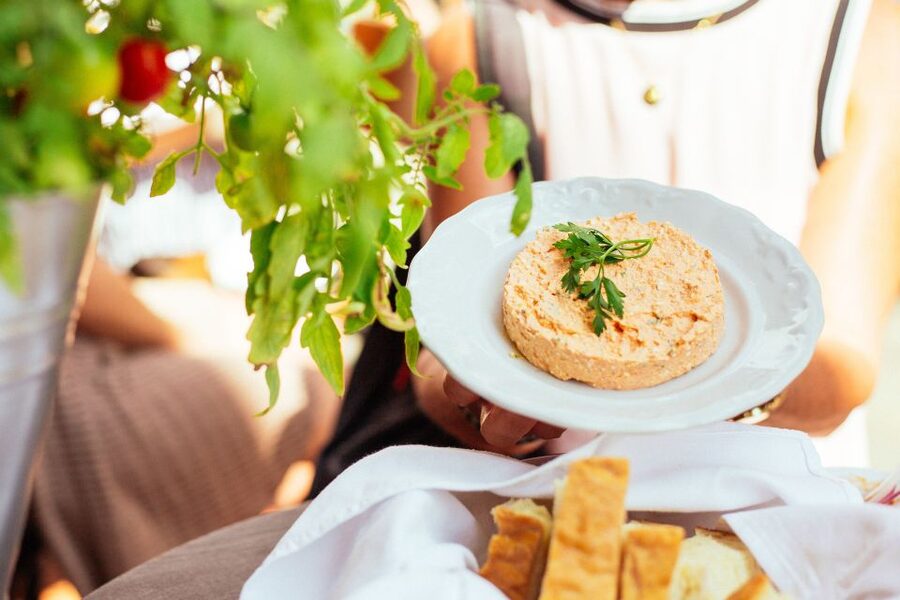
The food is part of the lesson. Sour cream plays a bigger role in Hungarian cooking than many first-time visitors expect, and the guide can show how it appears alongside savory dishes. You may also learn that paprika is not one single spice. Hungarian paprika ranges from sweet to smoky to hot, with different types used for different dishes.
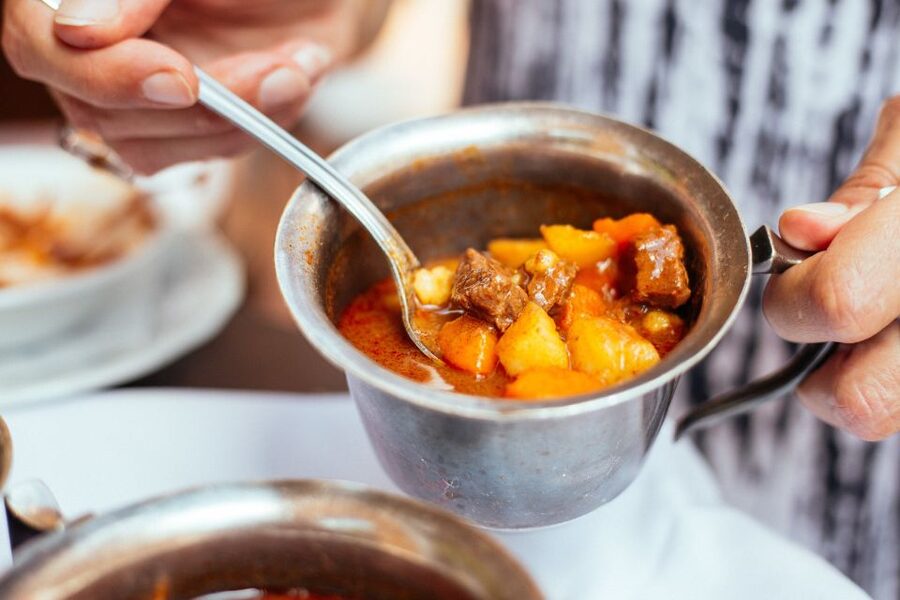
Goulash soup is another useful stop because it corrects a common misunderstanding. In Hungary, goulash is often a hearty soup rather than the thick stew many people know from restaurants abroad. A serving can be substantial, which is why it is wise to eat only a light breakfast or lunch before the tour.
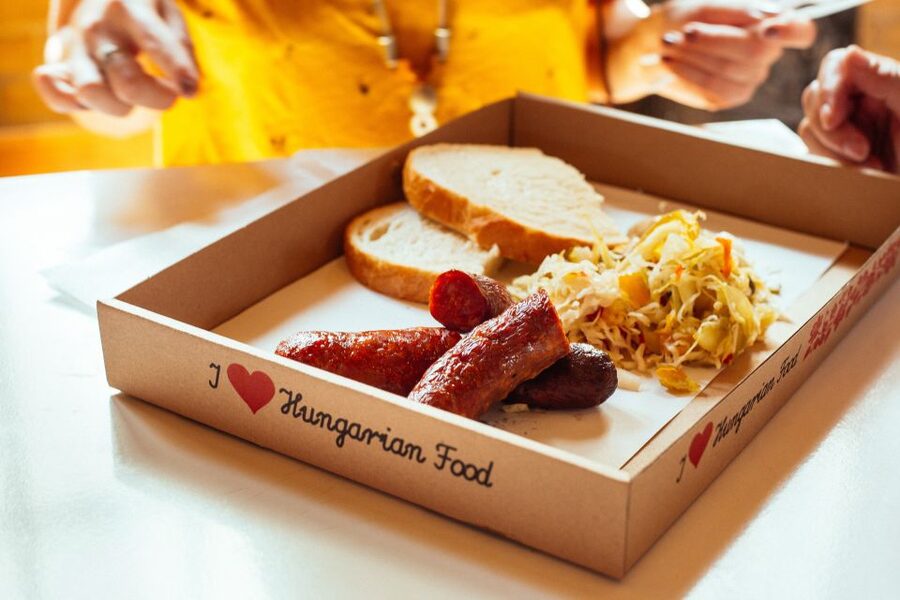
Sausage and bread may appear early in the route, especially around the market. It is a simple pairing, but it gives you a good sense of everyday Hungarian food. I prefer this kind of tasting to a polished restaurant plate because it shows how people actually snack and shop.
The Great Synagogue and Budapest’s Jewish Quarter
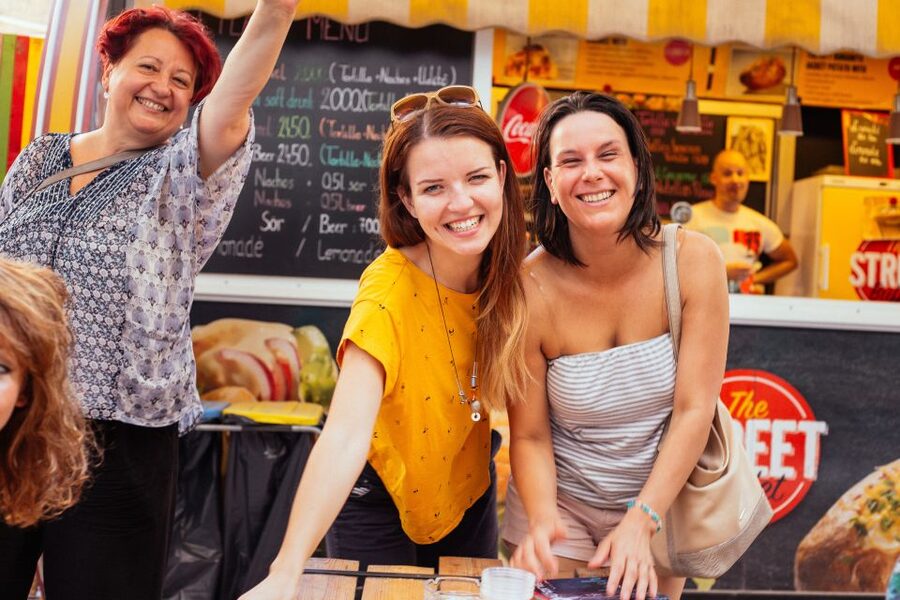
Food in Budapest cannot be separated from the city’s Jewish Quarter. The Great Synagogue provides an important landmark along the route, while the surrounding streets offer a mix of history, restaurants, bars, and casual food stands.
The tour does not present the synagogue as a quick photo stop with no context. Your guide explains its historical and cultural importance while connecting the district to food traditions. The result is more useful than simply ticking off another sight.
One route used public transit, including a tram, to move from the market toward the Jewish Quarter. That means the experience is not limited to one compact market area. You should expect some walking and city movement, rather than a fixed series of tastings inside one building.
A stop at an outdoor food court in the area included mici, a grilled meat dish popular across parts of Central and Eastern Europe. It adds another layer to the food story and shows that Budapest’s eating culture includes regional influences as well as strictly Hungarian classics.
More Private Food Tours in the world:
- Lisbon Exclusive PRIVATE Food Tour with 6 or 10 Tastings
★ 4.5 · 1,113 reviews - The Award-Winning PRIVATE Food Tour: 10 Tastings of 3 Cultures
★ 4.5 · 1,017 reviews - Rome Private Food Tour with 6 or 10 Tastings
★ 4.5 · 902 reviews - Lisbon Private Food Tour – Taste 10+ Local Dishes & Wines
★ 5.0 · 896 reviews
Szimpla Kert and Budapest’s ruin-bar culture
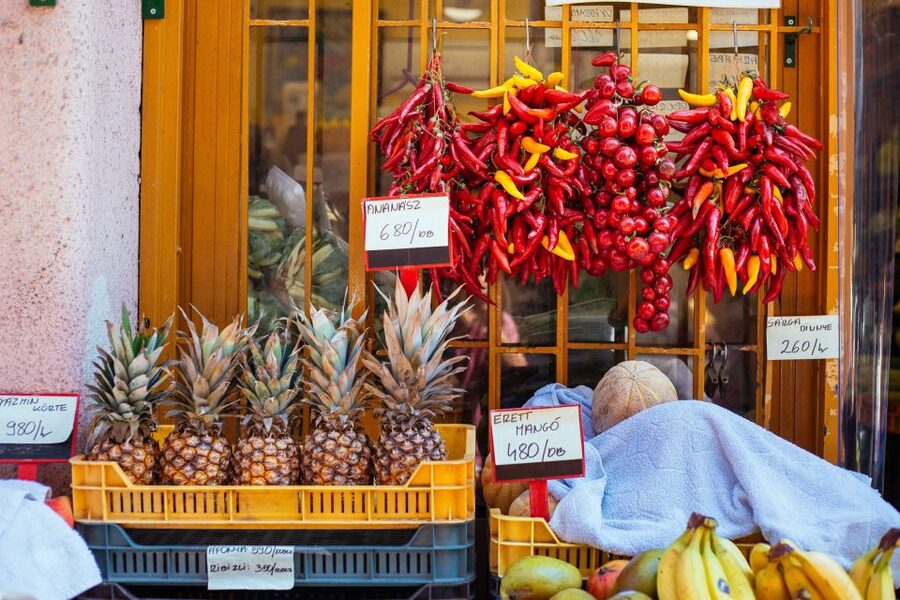
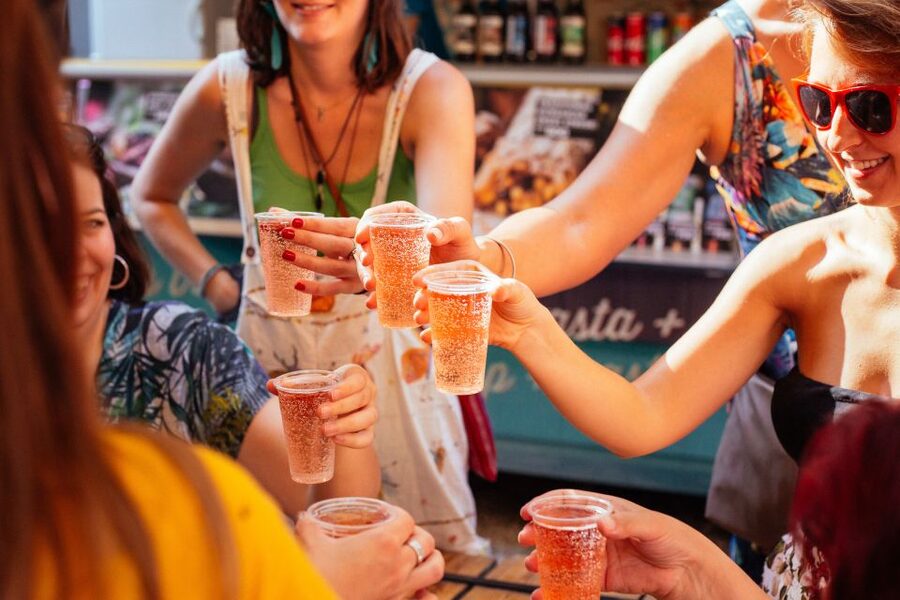
Szimpla Kert is one of the city’s best-known ruin bars, and it gives the tour a change of pace. The setting is famously eclectic, with mismatched decorations and a relaxed bar atmosphere. You may stop for a beer or another drink and take a short break from eating.
This part works because it shows a different side of Budapest. The market introduces traditional ingredients, while Szimpla Kert points to the city’s newer social culture. Your guide can explain why these unusual bars became such a recognizable part of the Jewish Quarter.
On Sundays, Szimpla Kert can be particularly useful. During the day, it may host a farmers market, providing one of the more interesting open options when other food halls and restaurants are shut. At night, it returns to its bar setting.
Do not expect the ruin bar visit to feel like a formal tasting room. It is more about atmosphere, local life, and having a drink in a distinctive place. If you dislike crowded or unusual bar interiors, this could be less appealing than the market and food stops.
Chimney cake and the sweet finish
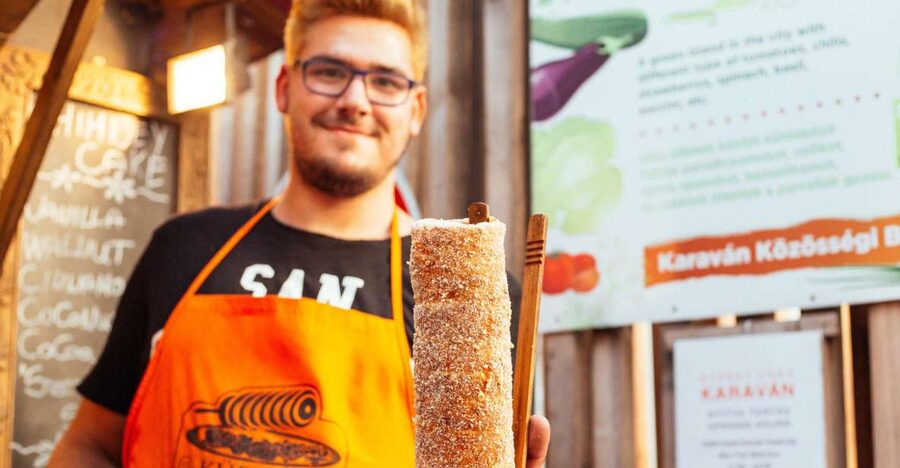
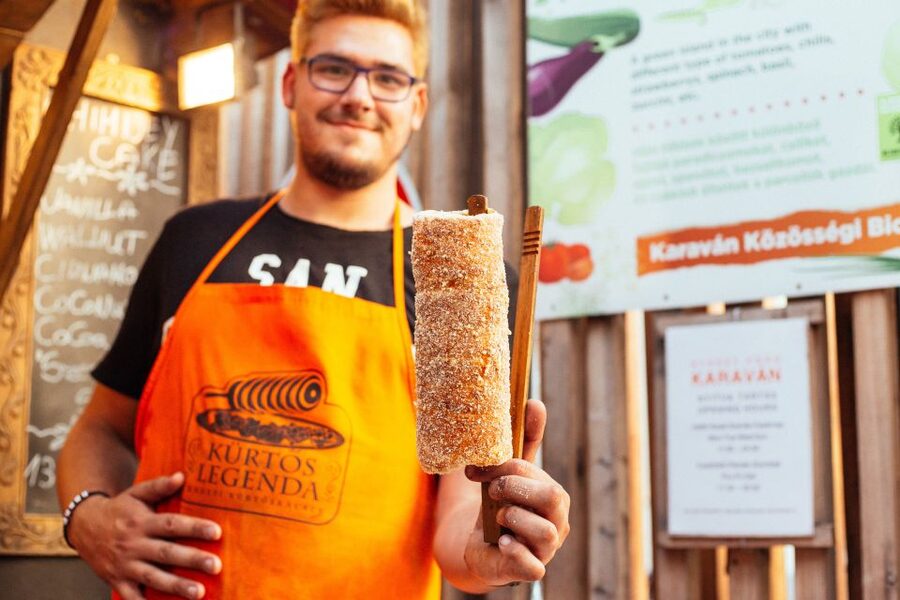
Chimney cake, known in Hungary as kürtőskalács, is the tour’s most obvious sweet classic. The dough is wrapped around a cylinder, baked, and coated with sugar or other toppings. The result is crisp on the outside, soft inside, and best eaten fresh.
This is another case where timing matters. A freshly prepared chimney cake is far better than one that has been sitting around. The tour’s local stops are meant to show the pastry in its proper form, rather than as a packaged souvenir.
Because the cake is substantial, it may arrive later in the route for good reason. After sausage, soup, lángos, and other tastings, you will probably be full. Several guests have finished the tour very satisfied, and one clear pattern is that you should not plan a large dinner immediately afterward.
The food is also a pleasant contrast to the savory dishes. Hungarian cooking can be heavy, especially when sour cream, fried dough, meat, and soup all appear in one afternoon. The sweet pastry gives the route a clear ending and keeps the menu from feeling one-note.
How much the private guide changes the experience
The private format is the strongest feature here. You are not trying to keep up with a large group or settle for a fixed menu that ignores your preferences. The host can ask what you like, learn about food restrictions, and adjust the afternoon.
Gabor, for example, began by asking about interests and food issues before shaping the route. That kind of conversation is useful even if you have no restrictions, since you can explain whether you prefer traditional dishes, sweets, drinks, or unusual local foods.
Vegetarian alternatives are available, but tell the guide at the start. The menu can be adapted, though you should not assume that every original tasting will have an identical substitute. If you avoid meat, fish, or seafood, say so clearly before the first stop.
The choice of guide can also shape the tone. Nick has been described as combining strong English with Hungarian roots and a broad grasp of local culture. Tibi, Beata, Gabor, Nelli, and Emoke have all led versions of the route, and the experience depends partly on the individual host’s personality and food interests.
That is a strength, but it also means the exact route is not completely fixed. You are booking a private food walk with a planned theme, not a guaranteed list of ten named restaurants.
What the $206 price means
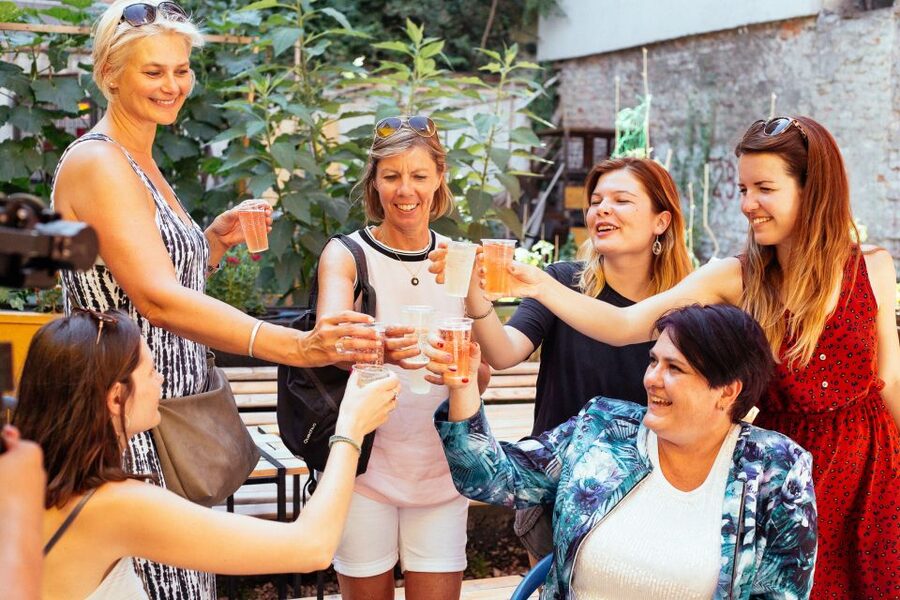
At $206 per person, this is not a budget snack crawl. The price makes the most sense for couples, families, or small private groups who value a personal host and want food, sightseeing, and cultural explanation in one booking.
The included 10 food and drink tastings help justify the cost. If the portions are generous, they can replace lunch and leave you full for much of the day. You are also paying for the guide’s route planning, explanations, local introductions, and ability to adjust the menu.
The value is weaker if you mainly want to eat cheaply or spend hours browsing the market on your own. Budapest offers many affordable food options, and an independent visitor could sample lángos, pastries, sausage, and drinks for much less.
I would compare it with the cost of separate activities. A private city guide, a meal, and a market visit can quickly add up, especially for first-time visitors who want someone to explain what they are seeing. For a short stay, the combined format can be efficient.
Hotel pickup and drop-off are not included. You need to reach the Great Market Hall independently, and the tour may use public transport during the route. Build in a little extra time to find the meeting point outside the entrance.
Timing, walking, and who should book
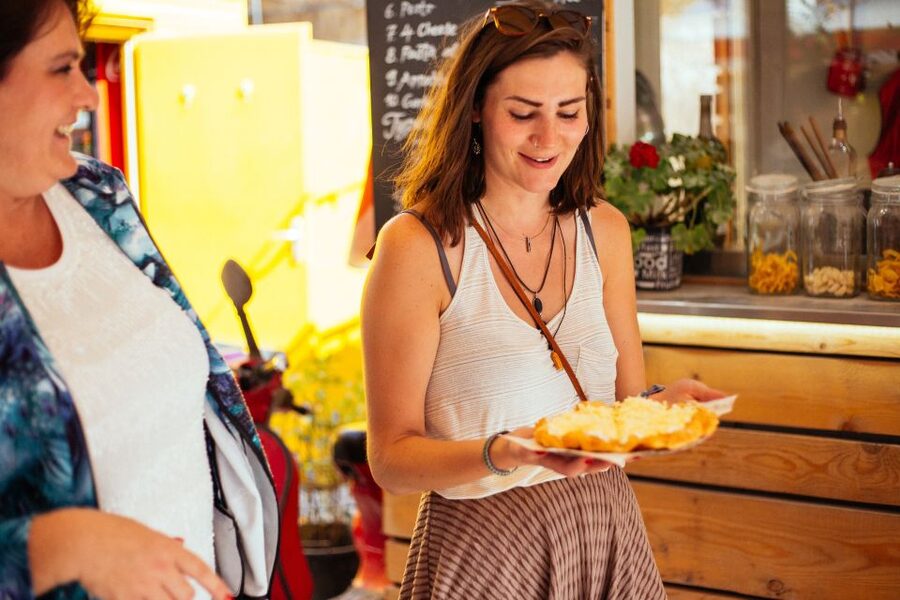
The tour lasts three hours, but it is active. You will walk between stops, stand in markets and food venues, and possibly use public transportation. Wear comfortable shoes, and avoid scheduling it immediately before another demanding activity.
This is a good first or second-day activity because it helps you learn which Hungarian foods you want to revisit. You can also ask the guide about areas you plan to explore later in the trip.
I would recommend it most to:
- First-time visitors who want an overview of Hungarian food without guessing what to order.
- Couples and small groups who like private tours and personal conversation.
- Food-focused visitors who want both traditional dishes and modern Budapest culture.
- People who want local context around paprika, sour cream, goulash, markets, and Jewish Quarter food.
- Vegetarians who tell the guide about their diet at the beginning.
It is less suitable for anyone with limited mobility. The activity is specifically not suitable for wheelchair users or people with mobility impairments. It is also a poor choice for picky eaters who dislike shared culinary surprises, since the main point is to try a broad selection.
A few smart ways to plan the afternoon
Eat lightly beforehand. Ten tastings can add up to a full meal, especially when goulash, lángos, sausage, bread, and chimney cake are involved.
Book on a day when the Great Market Hall is open if the market is important to you. Sunday remains possible, but the range of stops may be narrower.
Tell your guide about vegetarian needs, dislikes, or food restrictions at the start. The private format gives the host room to adjust, but only if the information is clear early on.
Keep the rest of the day flexible. You may finish full, and the walking route through the market and Jewish Quarter is part of the experience. A quiet evening or a light dinner is more realistic than another major meal.
The cancellation terms are practical for uncertain plans: you can cancel up to 24 hours in advance for a full refund, and you can reserve now while paying later. Those terms do not improve the food itself, but they make it easier to fit the tour into a changing Budapest schedule.
Should you book this food tour?
Book it if you want a private introduction to Hungarian food with city sightseeing built in. The strongest reasons are the 10 tastings, the guide’s ability to tailor the menu, and the chance to connect dishes with places such as the Great Market Hall, the Great Synagogue, and Szimpla Kert.
Skip it if you want the cheapest possible meal, need a fully wheelchair-accessible route, or plan to visit on Sunday mainly for the market. For everyone else, this is a useful way to get your bearings, learn what paprika and goulash really mean in Hungary, and leave with a good idea of which foods deserve a second helping.
FAQ
How long does the Budapest food tour last?
The tour lasts three hours. Starting times vary, so check availability when booking.
Where does the tour meet?
Your host meets you outside the entrance of the Great Market Hall.
How many tastings are included?
The experience includes 10 food and drink tastings, with savory, sweet, and drink options.
Is a vegetarian menu available?
Yes. Vegetarian alternatives are available. Tell your local guide at the beginning so the menu can be adapted.
Is hotel pickup included?
No. Hotel pickup and drop-off are not included, so you must make your own way to the Great Market Hall meeting point.
Is the tour suitable for wheelchair users?
No. The tour is not suitable for wheelchair users or people with mobility impairments.
Fresh off the menu around the world
- Taste of Chiang Mai: Michelin Guide & Street Food Tour★ 4.9 · 159 reviews
- Eat Porto Like a Local: The Ultimate Full-Meal Food Tour★ 5.0 · 97 reviews
- Vienna: The Ultimate Full Meal Austrian Food Tour★ 4.8 · 112 reviews
- Taste my Fribourg Self-Guided Food Tour★ 4.5 · 29 reviews
- Taste of Albania: Tirana Food Tour★ 5.0 · 26 reviews
- Jerez: Traditional Tapas Tour★ 4.6 · 138 reviews
- Taormina Pizza making class★ 4.8 · 140 reviews
- Taormina: Pizza Making Class with Lunch and Wine Tasting★ 4.8 · 145 reviews
Budapest Food Tours, compared.

Budapest Food Walking Tour: Eat, Sip & Explore Like a Local
Read our review →Budapest Centre Food Tour with 10+ Tastings, Wine & Street Food
Read our review →
From Budapest: Etyek Wine Tasting Tour with 3-Course Meal
Read our review →
Budapest Guided Food Walking Tour with Drinks Included
Read our review →
Budapest: Food Tour Market to Tavern: 14+ Tasters & Wines
Read our review →
Budapest: Guided Street Food Tour with Sweet Wine
Read our review →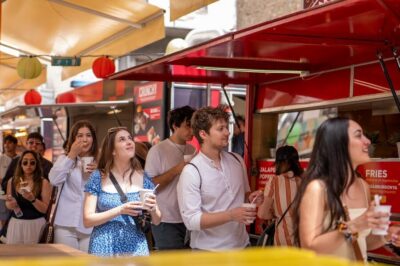
Budapest: Guided Food Tour with Wine, Beer, and Shots
Read our review →
Browse the lists this tour appears in